There is a real answer to this, and it is a temperature, not a date.
Asphalt needs air and ground temperatures of 50°F and rising. That is the Pennsylvania standard, and it is not a preference. Below that, the physics stop cooperating.
In practice, that gives most of Pennsylvania a season that ends somewhere around early November. But the calendar is not the rule. The thermometer is.
Why 50 Degrees Is the Line
Asphalt arrives hot, well over 200°F. From the moment it hits the ground it starts losing heat, and there is a window where it has to be compacted.
Compaction needs the mix to still be around 175°F. That is what presses out the air pockets and locks the stone together into a dense surface. Miss that window and you get a surface that looks finished but is full of voids.
Cold ground is what closes the window early. The ground pulls heat out of the mix from underneath, and cold ground pulls it out fast. That is why ground temperature matters as much as air temperature. A 55 degree afternoon after a hard frost is not the same as a 55 degree afternoon in October.
This is also why a sunny 58 degree day in late November can be misleading. The air feels workable. The ground is not.
What Actually Goes Wrong
When asphalt gets laid too cold, the failures are not obvious right away. That is the problem. The driveway looks fine in December and starts falling apart in March.
Poor compaction. The surface stays porous. Water soaks in instead of running off.
Raveling. Loose stone starts coming off the surface. You sweep up grit that used to be your driveway.
Early cracking. A weak surface cracks under normal use far sooner than it should.
Roller marks and uneven texture. The mix stiffened before it could be worked smooth.
Cold joints that separate. Where one pass meets another, the seam never bonds properly and opens up.
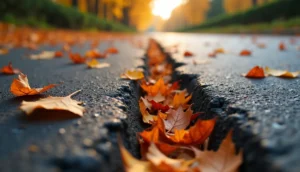
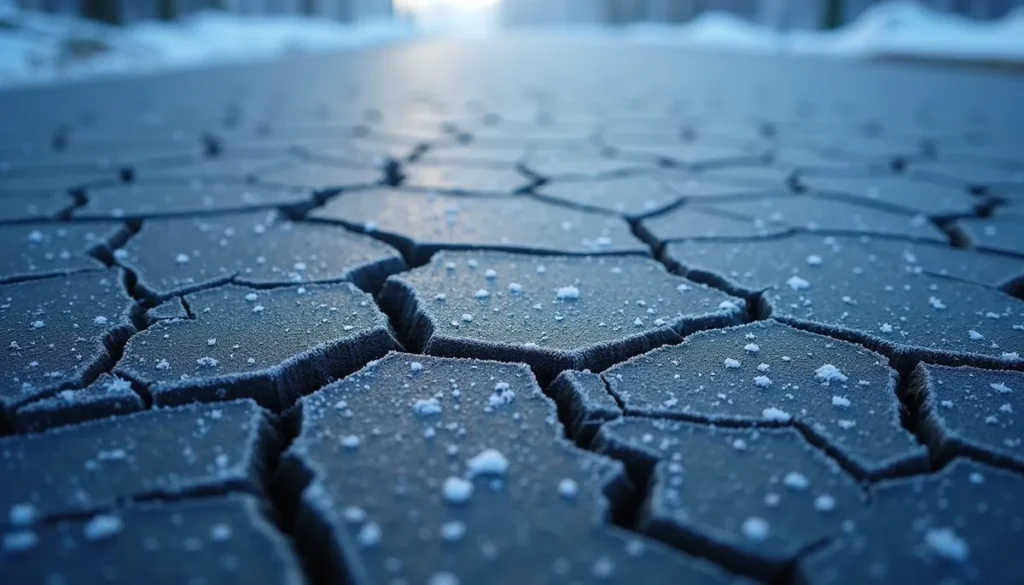
Then Pennsylvania winter finds every one of those weaknesses. Water gets into the voids, freezes, expands, and widens them. Freeze-thaw does in one season to a badly compacted driveway what it would take years to do to a good one.
The result is that paving too late often costs more than waiting, because you pay again sooner.
How to Tell If Your Driveway Was Paved Too Late
If you had work done at the tail end of a season and something feels off, look for:
- Loose stone or grit collecting on the surface
- Visible seams that have opened between passes
- Surface texture that is rough or uneven in patches
- Water soaking in rather than beading and running off
- Cracking within the first year
Any of those in a driveway less than a year old points to a compaction problem, not normal wear.
What to Do If You Miss the Window
Waiting until spring is almost always the right call. But you do not have to leave a bad driveway to get worse over winter.
Fill the cracks. This is the single most useful thing you can do. Every open crack is a path for water into the base, and water in the base during freeze-thaw is what causes real structural damage. Crack filling can be done later in the year than paving can.
Patch the potholes. Cold patch material exists for exactly this. It is not a permanent repair, but it keeps a hole from growing all winter and keeps people from twisting an ankle. Driveway patching is a normal late-season service.
Fix standing water if you can. Even clearing a blocked drain or a low spot at the edge helps. Water that sits is water that gets in.
Be careful with salt. Salt accelerates surface deterioration. On a driveway that is already compromised, sand gives you traction without the chemical damage.
Mark the edges before snow. Driveway markers keep a plow blade from catching a crumbling edge and tearing it up further.
Then get on a spring schedule early. Spring books up too.
Sealcoating Has an Even Earlier Cutoff
Worth knowing, because people assume sealing is the safer late-season option. It is not.
Sealcoat needs at least 55°F and rising, and temperatures must not fall below 50°F for 48 hours after it goes down. It also needs a dry window.
That means sealcoating shuts down earlier in the year than paving does, generally by around the third week of October. A warm November afternoon does not make it safe. If overnight lows drop into the 30s, curing stops and any remaining water in the mix can freeze and ruin the coat.
Frequently Asked Questions
What is the latest month you can pave a driveway in Pennsylvania? Usually early November, but it depends entirely on temperature that year. The requirement is 50°F and rising for both air and ground, not a specific date.
Can you pave in winter at all? Emergency and patch work happens year-round with different materials. Full paving in freezing conditions is not something a quality contractor will do, because it cannot be compacted properly.
It is 60 degrees in late November. Can we pave? Probably not. Ground temperature lags air temperature, and after a frost the ground stays cold even on a warm afternoon. Cold ground pulls heat out of the mix before it can be compacted.
Is cold patch a real fix? It is a temporary one. It keeps a pothole from spreading over the winter so you can do a proper repair in spring.
What can be done late in the season? Crack filling and patching are both viable later than paving. Both protect the base through winter.
Not Sure If You Still Have Time?
Nathan’s Paving & Seal Coating has worked in Central PA for over 20 years. If the season is closing, we will tell you honestly rather than take a job that will fail.
We also handle late-season protective work, including asphalt repairs in Harrisburg and asphalt repair in Carlisle to get a rough driveway through winter.
We hold a 4.8 star rating across 55 Google reviews. Estimates are free.
Call (717) 648-5030 or email nathanpaving@gmail.com.