
Church lots have an unusual pattern. They sit mostly empty all week, then fill completely for a few hours. That changes how they wear, how you schedule work, and how you should budget for it.
This guide is written for whoever is actually handling this: a trustee, a facilities committee, or a property team getting quotes.
Your Lot Wears Differently Than a Business Lot
A retail lot sees steady traffic all week. A church lot takes concentrated load in short bursts, then sits.
That produces a specific wear pattern:
Drive lanes and entrances fail first. Every vehicle passes through the same few paths. That is where the weight concentrates.
Parking stalls last longer. Cars sit there, they do not turn and brake there.
The sun does more damage than the traffic. A surface sitting empty and exposed most of the week loses its binder to ultraviolet light. That is why older church lots often look faded and dry rather than rutted.
Standing water goes unnoticed. Nobody is there Tuesday afternoon to see that a section holds water for two days after rain. That water is doing damage the whole time.
What this means practically: your lot may need less structural work than you expect and more surface protection than you expect. Get an honest assessment before assuming a full replacement.
Scheduling Around Services
This is the part that worries committees most, and it is very solvable.
The advantage you have is a predictable empty window. Monday through Thursday, most church lots are available. That is a better scheduling position than most commercial clients have.
Approaches that work:
Section by section, midweek. Work one area at a time Monday through Thursday, finish and open it before the weekend.
Full lot across a single week. If you can relocate parking for one Sunday, or you have overflow space, a whole small lot can often be done in one stretch.
Two-stage across two weeks. Half the lot one week, half the next. Both weekends have usable parking.
Things to raise with your contractor before scheduling:
- Which weekday events use the lot, and when
- Whether there is a funeral or wedding schedule to work around
- Where overflow or street parking exists if needed
- Which entrance must stay open for deliveries and staff
- Where the accessible spaces are and how they stay reachable
That last point matters more at a church than almost anywhere. Your congregation likely includes people for whom the walk from an overflow area is not workable. Plan accessible parking access into every phase, not just the finished result.
Fresh asphalt needs a few days clear of traffic, so build that into each section rather than assuming same-day use.
ADA Requirements
Any time you repave or restripe, accessible parking has to meet current standards. A repaving project is the right moment to fix it, because the lines are being redrawn anyway.
Under the 2010 ADA Standards, required accessible spaces depend on total spaces:
| Total spaces | Accessible required | Van-accessible |
|---|---|---|
| 1 to 25 | 1 | 1 |
| 26 to 50 | 2 | 1 |
| 51 to 75 | 3 | 1 |
| 201 to 300 | 7 | 2 |
| 301 to 400 | 8 | 2 |
The rule is that one in every six accessible spaces must be van-accessible.
Dimensions:
- Regular accessible spaces at least 8 feet wide
- Van-accessible spaces at least 11 feet wide
- Access aisles at least 60 inches, or 96 inches for van spaces
There are also rules covering signage and how much slope is permitted in an accessible space and its aisle.
Many older church lots were striped before the 2010 standards and are short on van-accessible spaces specifically. Worth counting yours now.
Budgeting a Large Lot in Stages
Church budgets do not usually have a large lot replacement sitting in them. The good news is that lot work divides well.
Get the whole lot assessed, then prioritize. A single assessment tells you which sections are failing and which are merely worn. Those are different problems with different price tags.
Fix what is failing, protect what is not. Structural repair on the bad sections, sealcoating on the sound ones. That is far less than replacing everything.
Stage across budget years. Drive lanes and entrances this year, stalls next year, sealcoat and stripe the following year. A written multi-year plan is also much easier to bring to a board than a single large number.
Do not defer crack filling to save money. It is the cheapest item and the one that prevents the expensive problems. Every open crack lets water into the base, and base failure is what turns resurfacing into replacement.
Ask for the assessment in writing, section by section. Then you have something to plan against and to show the committee.
Repair, Resurface, or Replace
Repair for isolated failures on a sound lot. Potholes, a sunken area, cracking along one lane.
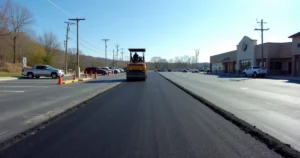
Resurfacing when the surface is worn but the base holds. Parking lot resurfacing puts a new layer over the old one for far less than replacement.
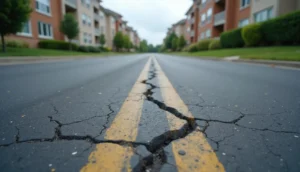
Replacement when the base has failed. The signs are alligator-pattern cracking and areas that sink back after every patch.
Most church lots we look at need resurfacing in the drive lanes plus sealcoating and striping elsewhere. Full replacement is less common than people fear.
Keeping It That Way
- Walk the lot each spring and note what changed over winter
- Fill new cracks as they appear
- Sealcoat on a regular rhythm to keep water and sun off the surface
- Restripe when lines fade, including accessible markings
- Watch drive lanes and entrances, since they fail first
Frequently Asked Questions
Will we have to cancel a service? Almost never. Church lots have a big midweek window, which makes them easier to schedule around than most commercial properties.
How many accessible spaces do we need? It depends on total spaces. A 60-space lot needs 3 accessible with 1 van-accessible. A 250-space lot needs 7 with 2 van-accessible.
Can we do this in phases across budget years? Yes, and for most churches that is the sensible approach. Get one full assessment, then stage the work by priority.
Our lot has not been touched in fifteen years. Do we need to replace it? Not necessarily. Age alone does not decide it. What matters is whether the base is still sound. That needs an on-site look.
What is the cheapest thing we can do that actually helps? Fill the cracks and correct any standing water. Both protect the base, which is the expensive part to fix.
Get a Free Assessment
Nathan’s Paving & Seal Coating has worked in Central PA for over 20 years. We handle church and institutional lots, including resurfacing, sealcoating, striping, and repair.
We hold a 4.8 star rating across 55 Google reviews. Estimates are free.
Call (717) 648-5030 or email nathanpaving@gmail.com. We will walk the lot, give you a section-by-section written assessment, and help you stage it to fit your budget.