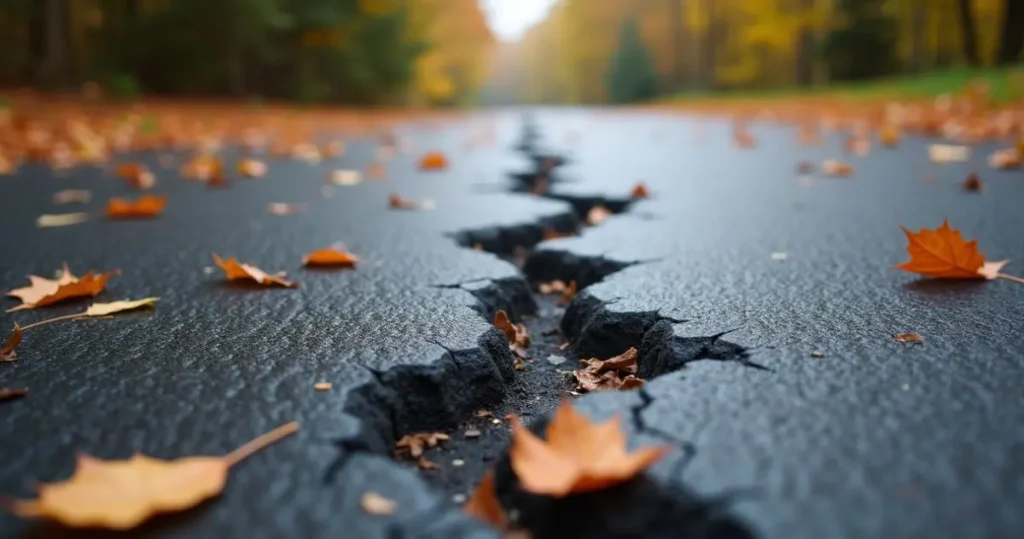
Fall is the time to deal with asphalt crack repair in Mechanicsburg, PA. The cracks you see now are small. After one winter of freezing and thawing, many of them will not be.
This guide explains why fall matters, how to read the cracks in your driveway or lot, and which fix fits each one. Some cracks need a quick fill. Some need a patch. A few are a sign that the base underneath has failed.
Why Should You Fix Asphalt Cracks Before Winter?
Cracks let water in. That is the whole problem.
In Cumberland County, winter brings a lot of freeze-thaw cycles. Water runs into a crack. At night it freezes and expands, which pushes the crack wider. In the day it thaws, and more water runs in. Then it freezes again.
Each cycle makes the crack a little bigger. Worse, the water soaks down into the base. The base is the layer of crushed stone under the asphalt that carries the weight. When the base gets wet and freezes, it heaves and softens. That is how a small crack turns into a pothole by March.
Road salt adds to the damage. So does the scrape of a snow plow along a weak edge.
Filling cracks in fall keeps the water out before the freeze-thaw season starts. It is one of the cheapest ways to protect your pavement.
What Kind of Cracks Do You Have?
Not every crack means the same thing. Here is how to read them.
Hairline cracks. These are thin surface cracks, often from sun and age. They are the earliest warning sign. They are a good reason to plan crack filling and sealing soon.
Single long cracks. These run in a line along or across the driveway. They often open and close as the seasons change. Cracks that move like this are called working cracks.
Block cracks. These form a pattern of large squares or rectangles. They usually come from the asphalt drying out and shrinking with age. The base is often still fine.
Alligator cracks. These look like the scales on an alligator’s back. They form small, connected pieces. This pattern usually means the base underneath has failed. Filling the surface will not fix it. For more detail, read our guide on how to fix alligator cracking in asphalt.
Should You Fill, Seal, Patch, or Replace?
Once you know the crack type, the fix gets clearer.
Crack filling uses a liquid asphalt material to fill stable cracks that do not move much. It is fast and low cost. It is a shorter-term fix and often needs to be redone after a season or two.
Crack sealing uses a hot, rubbery sealant that bonds to the crack walls. It stretches and shrinks as the crack moves. That makes it the better choice for working cracks. It lasts longer than filling.
We explain the difference in more detail in our post on crack sealing vs crack filling.
Patching means cutting out a damaged section and replacing it with new asphalt. This is the fix for small areas of alligator cracking or a pothole. The crew removes the bad asphalt, fixes the base below it, and fills the hole with hot asphalt.
Replacing is for driveways where the damage is spread across most of the surface. If alligator cracks cover large areas, patching one spot after another stops making sense. At that point, a new driveway with a rebuilt base is the real fix.
Can You Still Repair Cracks in Late Fall?
Yes, in many cases. Crack filling can be done later in the year than sealcoating can.
Sealcoat needs at least 55°F and rising, and no drop below 50°F for 48 hours after. That closes the sealcoat season around the third week of October in Central PA. Crack repair has more room than that. The cracks still need to be clean and dry for the material to bond.
So if you missed the sealcoat window, do not skip the cracks. Filling them now protects the base through winter. Then plan to sealcoat in spring.
What Happens If You Wait Until Spring?
One winter of waiting will not ruin every driveway. But it raises the odds that a small job turns into a bigger one.
Here is the usual path. A crack stays open through the fall rains. Water reaches the base. The first hard freeze lifts the edges of the crack. By January, pieces start to break loose. By March, the crack has become a shallow hole, and snow plows catch on it.
At that point, a simple crack fill is no longer enough. The area needs a patch, and the base under it needs work. That takes more time and more material.
Parking lots follow the same path, just faster. More cars and heavier trucks mean more pressure on each weak spot.
This is why we tell people that crack repair is one of the most useful fall jobs for asphalt that is still in fair shape. It costs less than the repair you avoid.
What Can Homeowners Do on Their Own?
Some small jobs are fine to handle yourself.
- Pull weeds out of cracks. Roots widen them.
- Blow or sweep dirt and sand out of cracks. Dirt can lock a crack open.
- Clear gutters and downspouts that dump water onto the driveway.
- Mark driveway edges with stakes before the first snow so plows stay off them.
Store-bought crack filler can work on thin, stable cracks. For wide cracks, moving cracks, or alligator cracking, it will not hold. Those need a pro repair.
Frequently Asked Questions
How wide does a crack have to be before I call someone?
If a crack is wider than a pencil, it should be repaired before any sealcoat goes on. Cracks that spread in a web pattern should be looked at no matter how wide they are.
Will sealcoating fix my cracks?
No. Sealcoat protects the surface. It does not fill cracks. Cracks get repaired first, then the seal coat goes on top.
Why does my crack come back every year?
It is likely a working crack that was filled with a material that cannot stretch. Hot rubberized crack sealing is built for cracks that move.
Is alligator cracking worth patching?
If it covers a small area, yes. The patch has to include the base under it. If it covers most of the driveway, replacing is usually the better use of your money.
More Mechanicsburg Paving Guides
Get a Free Estimate in Mechanicsburg
Nathan’s Paving & Seal Coating has worked in Central PA for over 20 years. We handle asphalt repairs in Mechanicsburg, from crack filling and sealing to patching and full driveway replacement.
We hold a 4.8 star rating across 55 Google reviews. Estimates are free, and we offer senior citizen discounts.
Call (717) 648-5030 or email nathanpaving@gmail.com. We will look at your cracks, tell you what kind they are, and recommend the fix that fits. Sometimes that is the small job, not the big one.