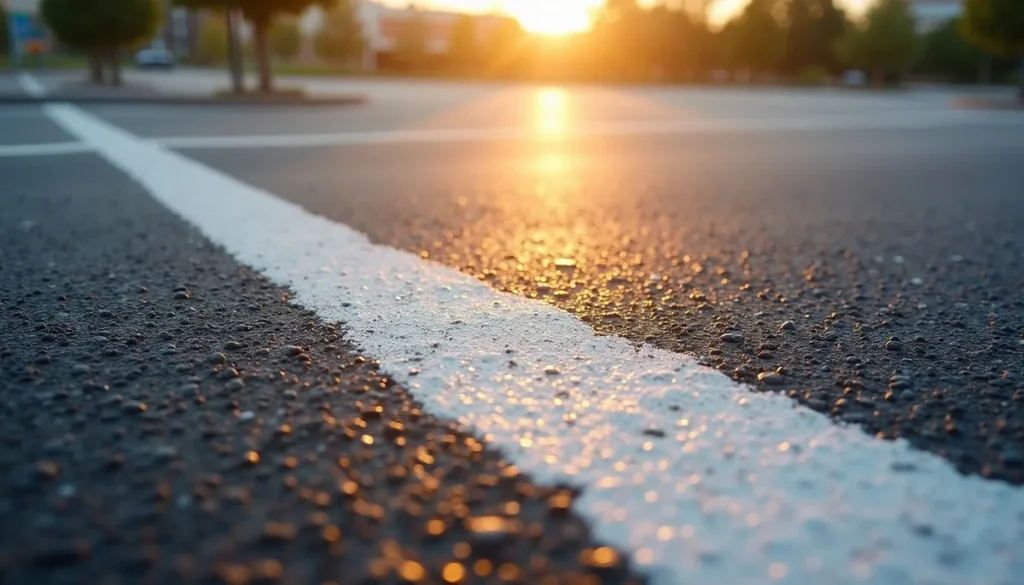
A parking lot is the first thing your customers touch. It is also one of the easiest things to let go too long, because the damage happens slowly.
This guide covers what commercial paving in Harrisburg actually involves: staying open during the work, meeting ADA rules, and what drives the cost.
You Do Not Have to Close
This is the first question every owner asks, and the answer is usually no.
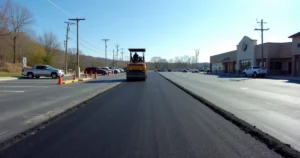
Lots get phased. The crew splits your lot into sections and works one at a time, keeping the rest open. Common approaches:
- Section by section. Half the lot stays open while the other half is worked.
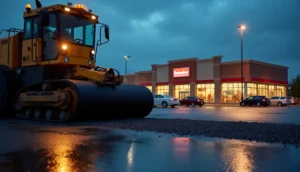
- After hours and overnight. Works well for retail and offices with predictable closing times.
- Weekend work. Good for business parks and medical offices that are quiet Saturday and Sunday.
- By entrance. Keep one entrance and the main drive lane open at all times.
What makes phasing work is planning it before the crew arrives, not during. Walk the lot with your contractor and identify which spaces matter most, where deliveries come in, and where the accessible spaces need to stay reachable.
Fresh asphalt needs to stay clear of traffic for a few days, so the schedule has to account for that in each section.
ADA Requirements Are Not Optional
Any time you repave or restripe, your accessible parking has to meet current standards. This is the part that most often gets missed, and it is the part that creates legal exposure.
Under the 2010 ADA Standards, the number of accessible spaces depends on your total space count:
| Total spaces in lot | Accessible spaces required | Of those, van-accessible |
|---|---|---|
| 1 to 25 | 1 | 1 |
| 26 to 50 | 2 | 1 |
| 51 to 75 | 3 | 1 |
| 201 to 300 | 7 | 2 |
| 301 to 400 | 8 | 2 |
Lots over 500 spaces use a percentage calculation instead.
The rule behind the last column is that one of every six accessible spaces must be van-accessible.
Dimensions matter too:
- Regular accessible spaces are at least 8 feet wide
- Van-accessible spaces are at least 11 feet wide
- Access aisles beside them are at least 60 inches wide, or 96 inches for van spaces
There are also requirements for signage and for how much slope is allowed in an accessible space and its aisle.
The practical takeaway: a repaving project is the right moment to fix accessible parking, because the layout is getting redrawn anyway. Fixing it later means restriping a lot twice.
Repair, Resurface, or Replace
Commercial lots rarely need everything done at once. Most need a mix.
Repair targets specific failures. Potholes, a sunken area near a dumpster pad, cracks along a drive lane. Cheapest option when the base is still sound.
Resurfacing puts a new layer over a lot whose surface is worn but whose base is solid. Big improvement for a fraction of replacement cost.
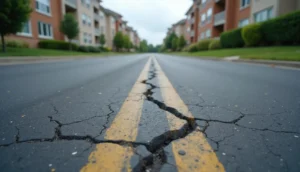
Full replacement is for a failed base. The signs are cracking in an alligator-skin pattern, areas that sink and return after patching, and standing water that has been sitting for years.
Most lots we look at need resurfacing in the main areas plus targeted repair in the heavy-traffic spots. Drive lanes, dumpster approaches, and delivery bays fail first because that is where the weight is.
What Drives the Cost
Square footage. The base number.
Base condition. The stone layer underneath carries the load. Commercial lots see far heavier weight than driveways, especially where trucks turn. A failed base has to be rebuilt.
Asphalt thickness. Commercial lots need more than residential driveways. Truck traffic needs more still. Get the spec in writing.
Drainage. Standing water is the leading cause of premature lot failure. If your lot holds puddles after rain, that gets addressed or the new surface fails early.
Phasing. Night and weekend work costs more than a straight daytime schedule. It is usually still cheaper than closing.
Striping and markings. Parking lot striping after paving includes stalls, directional arrows, fire lanes, and accessible markings.
Do Not Skip the Maintenance Plan
The lots that last are the ones on a schedule. The ones that need full replacement in eight years are the ones nobody looked at.
A simple yearly rhythm:
- Spring: walk the lot after winter. Look for new cracks, potholes, and spots where water is sitting.
- Fill cracks as they appear. A crack is an opening for water. Sealing it is cheap; letting water get into the base is not.
- Sealcoat on a rhythm. It keeps water and sun off the surface.
- Restripe when lines fade. Faded lines cost you usable spaces and create liability.
- Watch the drive lanes and dumpster pads. They fail first, and catching it early keeps a repair from becoming a replacement.
Frequently Asked Questions
How many accessible spaces does my lot need? It depends on the total. A 40-space lot needs 2 accessible spaces with 1 van-accessible. A 250-space lot needs 7 with 2 van-accessible. One in every six accessible spaces must be van-accessible.
Will I have to close my business? Almost never. Most lots get phased so part stays open, or the work happens overnight and on weekends.
How long does a parking lot take to pave? It depends on size and how it is phased. Phasing extends the calendar but keeps you open, which is usually the better trade.
When is the best time of year? Asphalt needs temperatures of 50°F and rising, which gives a season from spring through roughly early November in Central PA. Fall books up quickly.
Does resurfacing fix my drainage problem? Not by itself. If water pools because of how the lot is graded, a new surface follows the same slope. Drainage gets corrected as part of the work or the problem comes back.
Get a Free Commercial Estimate in Harrisburg
Nathan’s Paving & Seal Coating has worked in Central PA for over 20 years. We handle commercial paving in Harrisburg and parking lot installation for businesses, property managers, and facility teams.
We hold a 4.8 star rating across 55 Google reviews. Estimates are free.
Call (717) 648-5030 or email nathanpaving@gmail.com. We will walk the lot, tell you which sections need what, and put together a phasing plan that keeps you open.